

The Opportunity
- Europe possesses several large-scale rare earth deposits and exploration projects but currently has no operational rare earth mines. The Nordics hold Europe’s largest known rare earth deposits.
- Sweden, Norway and Finland are accelerating the development of the critical raw materials industry. The countries’ respective Mineral Strategies emphasize promotion of the sector from a long-term growth and resilience perspective, including international engagement and circular economy solutions.
- Europe wants to cut its dependence on China, whose exports meet 98% of EU rare earth magnet demand. The EU’s Critical Raw Materials Act, its RESourceEU plan and its list of strategic projects all favor Nordic supply.
- Nordic projects face a financing gap. New mines can take 10–15 years to develop, and few rare earth projects in the region have secured full financing, creating room for patient capital and offtake-linked equity.
- Europe’s biggest bottlenecks are refining and magnet-making. Companies that bring processing technology, offtake or downstream demand, can secure a role, and some processing may take place outside Europe.
Critical Mineral Endowment In The Nordics
Selected producing mines, deposits and refineries in Norway, Sweden, Finland and Greenland
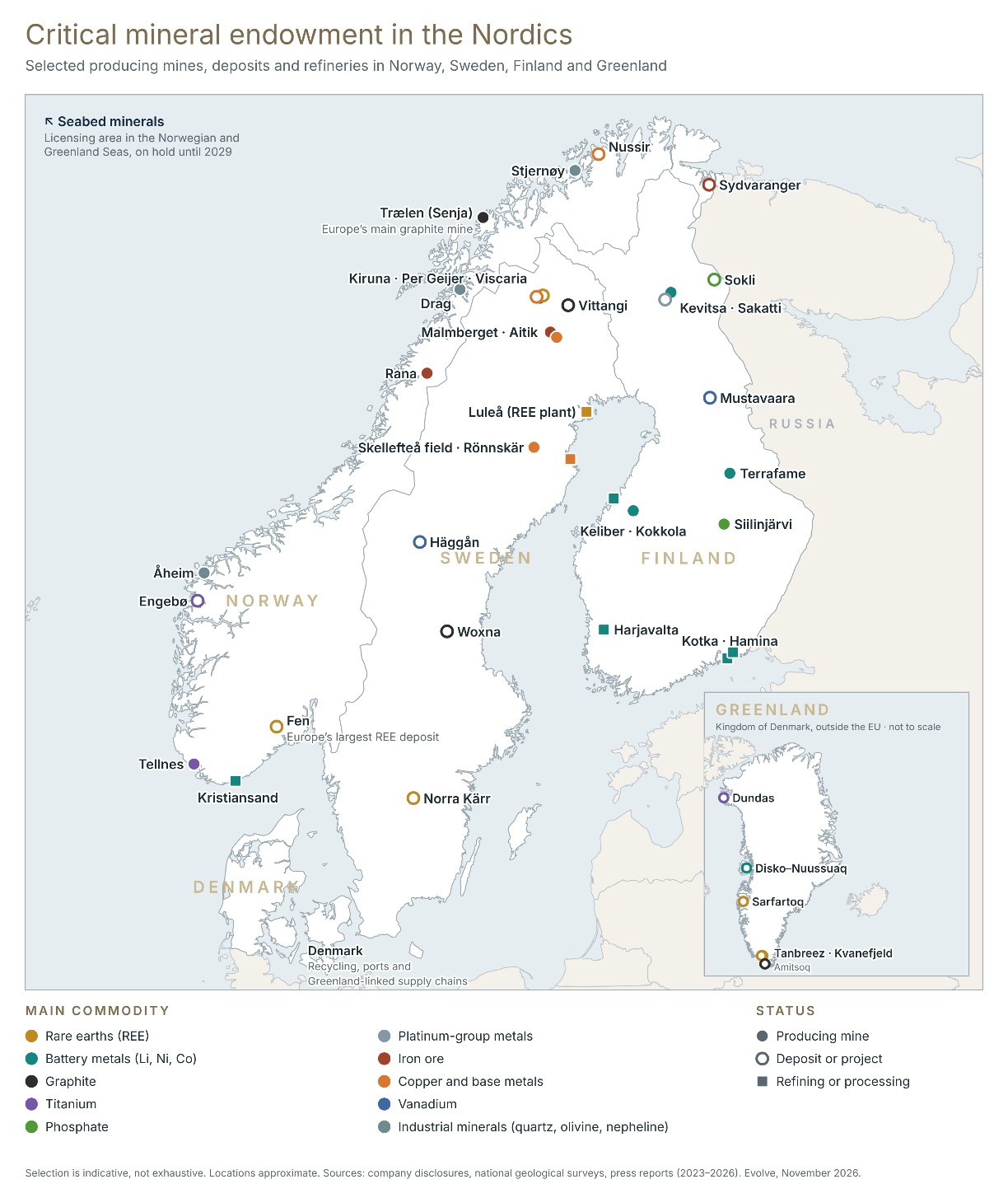
Select a country to see its sites. Select a site to zoom in. Press Escape to return to the full map.
Main Commodity
- Rare earths (REE)
- Battery metals (Li, Ni, Co)
- Graphite
- Titanium
- Phosphate
- Platinum-group metals
- Iron ore
- Copper and base metals
- Vanadium
- Industrial minerals
Site Status
- Producing mine
- Deposit or project
- Refining or processing
Norway
- Copper and base metals · Deposit or project
- Industrial minerals · Producing mine
- Graphite · Producing mine
- Iron ore · Deposit or project
- Industrial minerals · Producing mine
- Iron ore · Producing mine
- Industrial minerals · Producing mine
- Titanium · Deposit or project
- Rare earths · Deposit or project
- Titanium · Producing mine
- Battery metals · Refining or processing
Sweden
- Copper and base metals · Deposit or project
- Rare earths · Deposit or project
- Graphite · Deposit or project
- Iron ore · Producing mine
- Copper and base metals · Producing mine
- Rare earths · Refining or processing
- Copper and base metals · Producing mine
- Copper and base metals · Refining or processing
- Vanadium · Deposit or project
- Graphite · Deposit or project
- Rare earths · Deposit or project
Finland
- Phosphate · Deposit or project
- Battery metals · Producing mine
- Platinum-group metals · Deposit or project
- Vanadium · Deposit or project
- Battery metals · Producing mine
- Battery metals · Producing mine
- Battery metals · Refining or processing
- Phosphate · Producing mine
- Battery metals · Refining or processing
- Battery metals · Refining or processing
- Battery metals · Refining or processing
Greenland
- Titanium · Deposit or project
- Battery metals · Deposit or project
- Rare earths · Deposit or project
- Rare earths · Deposit or project
- Graphite · Deposit or project
The Background
- Nordic Endowment | Norway, Sweden and Finland host Europe’s leading mineral endowment and processing industries relevant for future green technologies, including actively sourced and identified deposits of lithium, copper, nickel, cobalt, graphite, rare earth elements, phosphate, titanium, vanadium, niobium, tantalum, and tungsten. The EU’s Critical Raw Materials Act (CRMA) defines the Nordic region as a key component of a more resilient European raw materials system.
- Europe’s mineral frontier | The northern bedrock is estimated to potentially meet the majority of European demand for critical raw materials if sufficiently explored. LKAB mines about 80% of the EU’s iron ore and is building a rare earth demonstration plant in Luleå. Rare Earths Norway estimates Fen at 15.9 million tonnes of rare earth oxides and targets production from late 2031. Keliber, majority-owned by South Africa’s Sibanye-Stillwater with the Finnish state holding 20%, is now producing lithium.
- Supply security drives policy | The EU wants to decrease its dependency on China as a supplier of critical minerals, with 2030 targets calling for at least 40% of consumption to be processed in the EU and no more than 65% to come from any single third country. Brussels has named strategic projects in Sweden and Finland, including LKAB’s rare earth project, the Viscaria copper mine and Arctial’s aluminium smelter.
- Shared supply-chain alliances | All three Nordic countries and India are members of the Minerals Security Partnership (now the Forum on Resource Geostrategic Engagement), a US-led international collaboration launched in 2022 to strengthen critical energy minerals supply chains. Sweden, Finland and Norway also signed the US-led Pax Silica declaration this year, as did the UAE, Qatar and India. Companies from these partner countries are better placed to be seen as trusted partners.
- Investment screening is tightening | Sweden screens investments in critical raw materials. Finland’s new law, due in early 2027, would make filing mandatory for strategic raw materials, including greenfield mines, for all foreign investors. The revised EU foreign investment screening regulation applies from 17 January 2028. It requires all Member States to screen covered investments in a common set of sensitive sectors, including critical raw materials.
- Greenland is a geopolitical flashpoint | US-listed Critical Metals won approval in May 2026 to take control of the Tanbreez rare earth project and signed a non-binding plan to refine part of its output in Saudi Arabia. Kvanefjeld, partly Chinese-owned, has been blocked since a 2021 uranium ban and is in arbitration.
- Permits and social license take time | Norway’s government took over planning for Fen in April 2026 to speed it up. Sámi land rights, environmental rules and local opposition slow projects across the region. Sweden’s new minerals strategy (July 2026) proposes faster, more predictable permits and more benefit-sharing with host communities.
What Non-European Investors Should Know
The Nordics are in growing need for capital to live up to its critical minerals ambitions. This is creating real entry points for international investors. With many projects still early-stage, investors who engage now could secure stakes, offtake and influence on favorable terms.
- The region is actively courting investors and this opens doors for matchmaking and support, as well as potentially favorable entry terms for well-prepared international partners.
- Permitting is getting faster and more predictable and investors who move early can secure positions while valuations are still low.
- Minority stakes, joint ventures and offtake-linked investments face fewer screening hurdles than control of a strategic asset.
- Early-movers can become part of Europe’s supply-security architecture and partners in strategic projects, resulting in access to EU support, faster permits and long-term European demand.
- Investors who bring technology, offtake or downstream demand can secure roles that last for decades as refining, separation, battery materials and recycling remain Europe’s real bottlenecks.